Whiteface/blacklegs: A post about tights, makeup, and black ballerinas

Updated: Feb 8, 2019
Unless you are living under a rock, you will have heard at least something about the controversy brewing in Virginia, where several prominent white male politicians are suddenly facing up to incidents in their past where they donned blackface. If you are interested in the topic, you might have also treated yourself to some information about the history of minstrelsy, blackface performance by both white and black entertainers, and a rehashing of past incidents where people have had to apologize for both historical and contemporary blackface use. If you are VERY interested, I recommend that you search "Ben Vereen blackface" and refresh yourself on that incident and the quite arresting recent installation that reexamines it. Heck don't even bother, just click here.
I had thought about writing something myself about minstrelsy and the phenomenon of blackface, but there's plenty out there. Instead, I got to thinking about tights.
Dancewear, like any other clothing is subject to fashion. When I was a young dancer in the 1980s we had leg warmers, high cut leotards, weird shimmery tights, and headbands. When I returned to teaching in the early 2000s, my students eschewed tights. Booty shorts and bare legs ruled the day. Those were the days of unnecessary layering - sweaters that covered only your arms, always something tied around the waist - lots of things that seemed designed to destroy the body line. These days, the fashion is for wearing socks all the time (and, boy, I can't wait for the day when these dancers look back in horror on THAT travesty).
However, there is one place that never goes in for fashion: the ballet studio. The uniform there is much as it was in 1957 when George Balanchine debuted Agon and dressed his dancers in "rehearsal clothes." Then and now, girls wear pink tights, black leotards, and pink slippers. Boys wear black tights, white shirts, white socks and black or white shoes. Ballet loves discipline. Ballet loves uniformity. And classical ballet is very, very white.
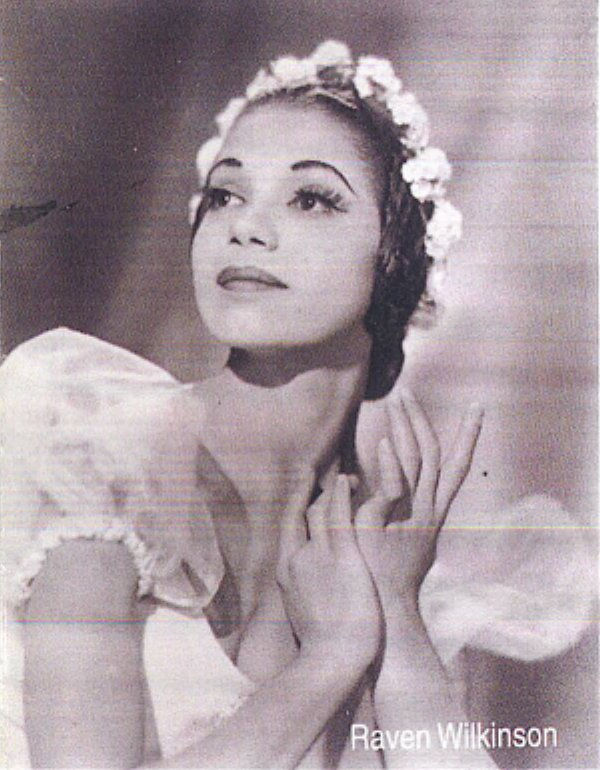
I remember the first time anyone drew my attention to the inherent racism in Band-Aids. Designed to blend into skin tone (if never perfectly), Band-Aids assume that skin is pale. Pink tights make the same assumption, and the history of ballet tells us this is no mistake. In 1932, a black ballerina named Janet Collins turned down a job with the Ballets Russes de Monte Carlo - one of the premier companies in the world - because her position required her to wear whiteface makeup. Some twenty years later, Raven Williams accepted a job with the same company, on the same condition.
Raven Williams' story of dancing on tour is harrowing. In southern cities, she might be replaced onstage by a white understudy if the crowd seemed too dangerous. Or she might be refused lodging with the company if anyone asked about her race. That part of the story is familiar; indeed the recent movie Green Book explores some of the same themes. However, white face is peculiar to classical ballet, and it points to a structural issue that is changing only very recently.
The uniformity of ballet is an aesthetic. Female ballet dancers are expected to be uniform, and in some cases very nearly identical. Check out this example, from the ballet Giselle. Black dancers do not conform to this aesthetic, and were excluded. Combine this with the structure of ballet companies: one starts as an apprentice, moves to the corps (who perform dances such as the one in the link), eventually becomes a soloist, and then a principal. It's kind of like the military, which is not surprising, since the structure was built in Imperial Russia where dancers wore uniforms in their spare time and worked for the Tsar. In any case, if you can't fit into the corps, you can't progress up the chain of the profession. (Note: There were other, more blatant reasons given to exclude black dancers from ballet over the years; the issue of uniformity was generally presented as the most neutral).
There have been exceptions in the major ballet companies since the mid-20th century, but the real change came with the founding of all-black ballets, such as the Dance Theatre of Harlem, founded in 1969. All-black companies provided the training ground that black dancers needed to prove their mettle. Once trained and performing at a high level, those dancers might make it into the big companies. We have been treated recently to the elevation of Misty Copeland to principal of the American Ballet Theatre. She was the first African-American dancer to rise to that position, and it happened in 2015. Pause and think about THAT date for just a moment. There are other names that we can add to this list: Anne Benna Sims, who achieved the rank of soloist for ABT in the 1970s, Lauren Anderson, the first black female principal in a major company (1990).
Here's the thing: we can spend a lot of time during Black History Month posting the names of pioneers. Can you think of another field, where having named the "first" we can still count the "subsequent" on two hands? Having just celebrated the 100th anniversary of Jackie Robinson's birth, wouldn't we be shocked to find a list of top black baseball players numbering so small? Dance, in its myriad forms, has vast numbers of talented and famous dancers of color. Classical ballet is far behind. But, I did notice something recently that may suggest that change is accelerating.
When tights started to reappear on my dancers' legs about five years ago, I launched a search to see if I could find a brand that provided a variety of skin tones. My black dancers needed better than the old "suntan" tights of my youth, and they needed not just one darker shade, but several. I tracked down a small vendor called "Shades of Dance" and ordered a number of pairs. The tights were fine, though the customer service was dreadful. One dancer waited weeks for her order and could never get through to anyone by email or phone. But "Shades of Dance" was it: we used them because we had no other options. Just recently, I made this search again. "Shades of Dance" has disappeared, but over at Discount Dance, the biggest online retailer of dance wear, the major companies have stepped up. Capezio and Theatricals have multiple shades, and Bloch is offering at least one. I don't know if these tights are being seen yet in ballet studios, or whether the standard uniform description might someday read "pink/skin tone tights." I fear that we are a way off from a brown-legged swan in a line of pink-tighted dancers. But at least now, the young black dancers who are still years away from their first apprenticeship can find themselves in the dance wear section, where the tights fit the girl, rather than the other way round.
And look! Shoes as well!


Comments